
Class 6 Worksheet on Analyzing Imagery in Texts

Class 6 Worksheet on Analyzing Imagery in Texts
Imagery Investigator: Analyzing Sensory Language Across Texts for Grade 6
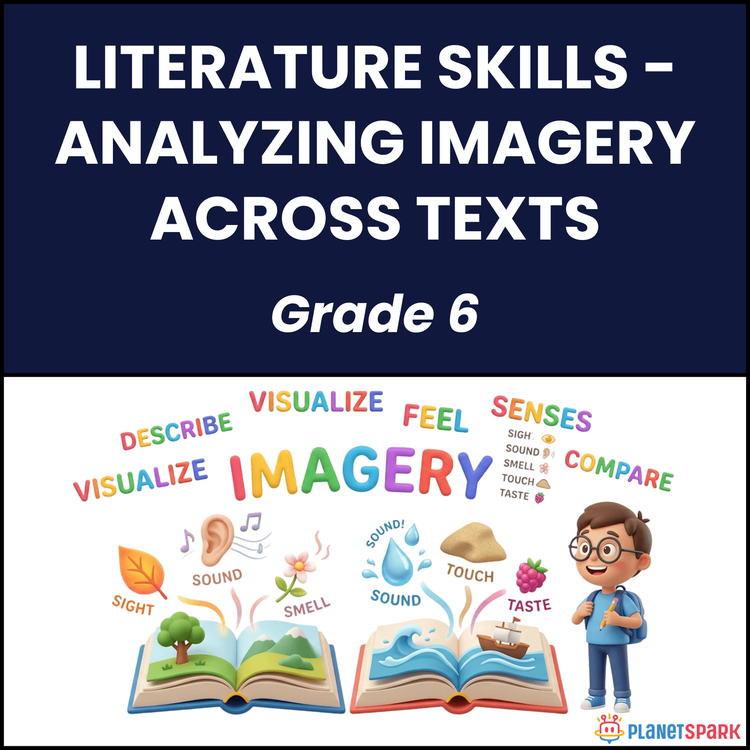
This Grade 6 literary analysis worksheet teaches students how to analyze imagery — the use of vivid sensory language that creates pictures in the reader's mind. Using the richly descriptive original story "The Monsoon Kitchen," students follow twelve-year-old Meera as she experiences the arrival of the monsoon through sight, sound, smell, touch, and taste alongside her grandmother Ajji. Task types include multiple-choice questions, fill-in-the-blanks, true/false corrections, sentence-based vocabulary selection, and a short paragraph writing exercise that asks students to analyze how the author uses imagery with two examples and their effects. This worksheet builds essential skills for analyzing figurative language and sensory details — a key requirement for close reading and literary analysis essays.
Why Is Analyzing Imagery Important in Literary Studies?
Imagery helps readers see, hear, feel, smell, and taste what characters experience. For Grade 6 learners, learning to analyze imagery is important because:
1. It teaches students to notice how authors create mood, atmosphere, and emotion through sensory details.
2. It builds vocabulary for describing different types of imagery (visual, auditory, tactile, olfactory, gustatory).
3. It prepares students for close reading and evidence-based literary analysis.
4. It helps students become better writers by showing how vivid descriptions bring stories to life.
What's Inside This Worksheet?
This worksheet includes five literature-based activities that strengthen imagery analysis skills:
🧠 Exercise 1 – Multiple Choice Questions (Story Recall)
Students answer 10 questions based directly on "The Monsoon Kitchen," testing memory of sensory details and key imagery. Example: "How did the raindrop hit?" (Like a coin)
✏️ Exercise 2 – Fill in the Blanks
Students complete 10 sentences using keywords from the story, reinforcing vocabulary and main ideas. Example: "The raindrop hit the ______ courtyard." (dusty)
✅ Exercise 3 – True and False (with Correction)
Students read 10 statements and mark them true or false. Each false statement must be corrected using story details, promoting careful reading. (This worksheet has 5 true and 5 false statements.)
📖 Exercise 4 – Underline the Correct Word
Students choose the correct word or phrase from options to complete each sentence accurately based on the story. Example: "The clouds had been building all week like (old pillows / wet blankets / heavy stones)."
📝 Exercise 5 – Paragraph Writing (Analyzing Imagery)
Students write a 60–80 word paragraph analyzing how the author uses imagery in the story, providing two examples and explaining their effects. This directly builds literary analysis skills focused on figurative language.
✅ Answer Key (For Parents & Educators)
Exercise 1 – Multiple Choice Questions
1. b) Like a coin
2. b) The clouds
3. a) The kitchen
4. c) The windowsill
5. c) The raindrops
6. b) The steam
7. a) The knife
8. a) A lizard
9. c) The rain
10. c) The world
Exercise 2 – Fill in the Blanks
1. dusty
2. swollen
3. twelve
4. pollen
5. lower
6. petal
7. bled
8. cotton
9. mango
10. sang
Exercise 3 – True and False (with Corrections)
Statement 1: False → The crow flew to the neem tree (not banyan tree).
Statement 2: True
Statement 3: False → Ajji chopped tomatoes (not potatoes) on the wooden board.
Statement 4: True
Statement 5: False → Meera was twelve years old (not ten).
Statement 6: False → The windowsill felt warm and rough (not cold and smooth).
Statement 7: True
Statement 8: True
Statement 9: False → The gutter became a small waterfall (not a small lake).
Statement 10: True
Exercise 4 – Underline the Correct Word
1. old pillows
2. mustard seeds
3. golden petal
4. woodpecker attacking
5. pink
6. clapping
7. steel bowls
8. spectacles
9. twice
10. sang
Exercise 5 – Paragraph Writing (Analyzing Imagery - Sample Answer)
The author uses vivid imagery to bring the monsoon kitchen to life. First, auditory imagery: "The sound was a million tiny hands clapping all at once" describes the gutter's waterfall, making readers hear the rain's intensity. Second, visual and tactile imagery: "The flame was a small blue flower that grew into a golden petal" turns a simple kerosene stove flame into something beautiful and alive. The author also compares the steam to "a snake dreaming of the sky" and Ajji's knife to "a woodpecker attacking a tree." These images help readers feel, see, and hear the kitchen as if they are standing beside Meera. The effect is immersive — we don't just read about the rain; we experience it with all five senses.
Help your child master imagery analysis and sensory language interpretation with a Free 1:1 Communication Skills Trial Class at PlanetSpark.
Frequently Asked Questions
Imagery uses descriptive language to create vivid pictures in the reader's mind, and analyzing it helps identify themes and emotions in the text.
Imagery can reveal the mood, setting, and deeper meanings that enhance the overall comprehension of the story.
By practicing with visual exercises that connect words with images and discussing the impact of descriptive language.