
Class 6 Worksheet on Conflict vs Resolution in Texts
Class 6 Worksheet on Conflict vs Resolution in Texts
Conflict Solver: Comparing Internal & External Resolutions for Grade 6
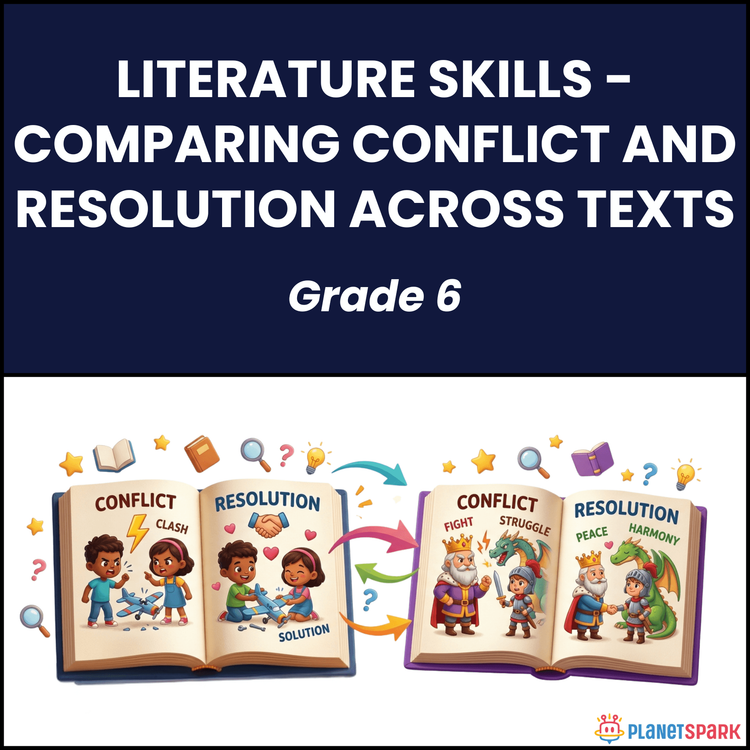
This Grade 6 literary analysis worksheet helps students understand the difference between internal and external conflicts and how characters resolve them in satisfying ways. Using the original story "Four Fights, Four Finish Lines," students follow Rohan as he compares four characters — Meera, Arun, Anika, and Leela — each facing a unique struggle. Task types include multiple-choice questions, fill-in-the-blanks, true/false corrections, sentence-based vocabulary selection, and a short paragraph writing exercise that asks students to compare two characters' resolutions. This worksheet builds critical thinking about story structure and prepares students for comparative literary analysis.
Why Is Understanding Conflict and Resolution Important?
Conflict drives every story, and resolution shows how a character grows. For Grade 6 learners, comparing conflicts across texts is important because:
1. It teaches students to identify internal struggles (within a character) vs. external struggles (with outside forces).
2. It shows that different problems need different solutions — there is no "one way" to resolve a conflict.
3. It builds comparative analysis skills needed for essays and exams.
4. It helps students understand that a satisfying resolution always involves character growth.
What’s Inside This Worksheet?
This worksheet includes five literature-based activities that strengthen understanding of conflict types and resolutions:
🧠 Exercise 1 – Multiple Choice Questions (Story Recall)
Students answer 10 questions based directly on "Four Fights, Four Finish Lines," testing memory of characters, conflict types, and resolutions. Example: "Whose conflict was internal?" (Meera)
✏️ Exercise 2 – Fill in the Blanks
Students complete 10 sentences using keywords from the story, reinforcing vocabulary and main ideas. Example: "Rohan drew a ______ of four characters." (chart)
✅ Exercise 3 – True and False (with Correction)
Students read 10 statements and mark them true or false. Each false statement must be corrected using story details, promoting careful reading. (This worksheet has 5 true and 5 false statements.)
📖 Exercise 4 – Underline the Correct Word
Students choose the correct word from three options to complete each sentence accurately based on the story. Example: "Rohan chose (four / five / six) characters."
📝 Exercise 5 – Paragraph Writing (Comparing Conflicts & Resolutions)
Students write a 60–80 word paragraph comparing how two characters from the story resolved their conflicts and explaining why each resolution fit their problem. This builds comparative analysis and evidence-based writing.
✅ Answer Key (For Parents & Educators)
Exercise 1 – Multiple Choice Questions
1. b) Meera
2. b) A road
3. c) Internal & external
4. a) Patience
5. b) Fight
6. c) A kite fight
7. c) The bangle
8. a) Brokenness
9. c) Rohan
10. a) The character grows
Exercise 2 – Fill in the Blanks
1. chart
2. understand
3. destruction / threat (either accepted)
4. confidence / doubt (either accepted based on phrasing)
5. important
6. patience / acceptance (either accepted)
7. courage
8. temporary
9. crack / brokenness (either accepted)
10. character
Exercise 3 – True and False (with Corrections)
Statement 1: False → Rohan compared four characters (not five).
Statement 2: True
Statement 3: False → Arun's tree was threatened by a new road (not a new school).
Statement 4: False → Anika's conflict was both internal and external (not only external).
Statement 5: True
Statement 6: False → Meera resolved her conflict by slowing down and observing (not by running away).
Statement 7: True
Statement 8: False → Anika learned that winning and losing are both temporary (not that winning is permanent).
Statement 9: True
Statement 10: True
Exercise 4 – Underline the Correct Word
1. four
2. both
3. crack
4. nose
5. save
6. bangle
7. grandpa
8. no one way
Exercise 5 – Paragraph Writing (Sample Answer)
Meera resolved her internal conflict of impatience by slowing down and observing the rain. She pressed her nose to the glass and listened, learning that patience leads to understanding. This resolution fit because her problem was inside herself — no outside force could fix it. In contrast, Arun faced an external conflict: a road threatening his tree. He resolved it by deciding to fight even if he might lose. His resolution was commitment to action, which fit his external problem because he had to take real-world steps. Both grew, but through different paths.
Help your child master conflict analysis and comparative literary writing with a Free 1:1 Communication Skills Trial Class at PlanetSpark.
Frequently Asked Questions
Conflict is the central problem or challenge that characters face, while resolution is how the conflict is solved or concluded.
By paying attention to the problem introduced early in the story and noticing how it is resolved by the end.
They drive the plot forward and help students understand the story's structure and the message the author is trying to convey.