
Class 6 Grammar Worksheet on Comparing Author Styles

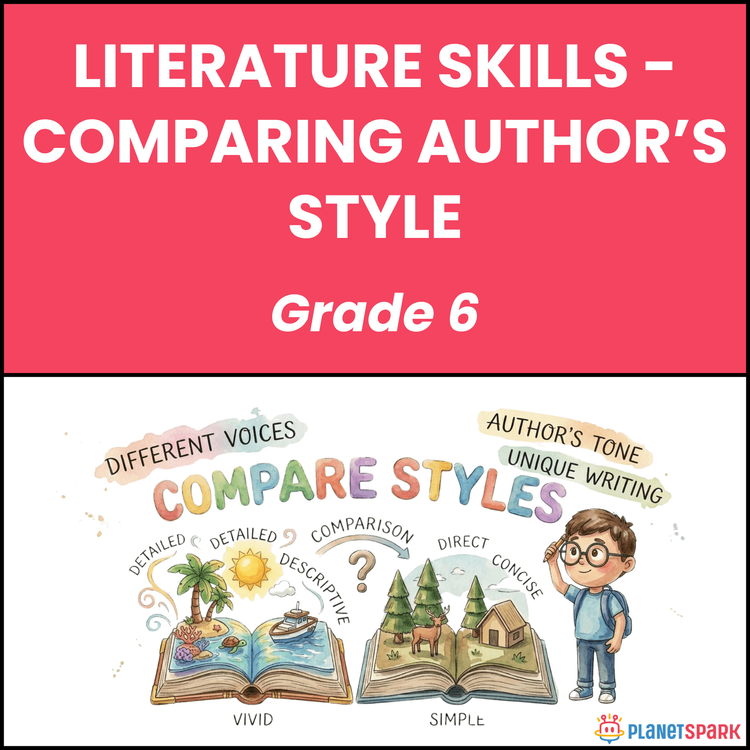
Class 6 Grammar Worksheet on Comparing Author Styles
Style Spotter: Comparing Author's Craft & Literary Techniques for Grade 6
This Grade 6 literary analysis worksheet teaches students how to compare author's style — the unique way a writer uses language, imagery, similes, and sensory details to create meaning. Using the evocative original story "The Banyan Tree and the Boy," students follow Arun as he connects with an ancient tree and learns that some things are worth fighting for, even if they don't need saving. Task types include multiple-choice questions, fill-in-the-blanks, true/false corrections, sentence-based vocabulary selection, and a short paragraph writing exercise that asks students to compare the author's style in this story with another story they have read. This worksheet builds essential skills for analyzing and comparing author's craft — a key requirement for advanced literary studies and essay writing.
Why Is Comparing Author's Style Important in Literary Analysis?
Author's style includes word choice, sentence structure, imagery, figurative language, and tone. For Grade 6 learners, learning to compare authorial style is important because:
1. It teaches students to notice how writers create mood, atmosphere, and emotion.
2. It builds vocabulary for describing literary techniques (simile, metaphor, personification, sensory details).
3. It prepares students for advanced close reading and stylistic analysis essays.
4. It helps students become better writers by studying what makes different authors unique.
What's Inside This Worksheet?
This worksheet includes five literature-based activities that strengthen author's style comparison skills:
🧠 Exercise 1 – Multiple Choice Questions (Story Recall)
Students answer 10 questions based directly on "The Banyan Tree and the Boy," testing memory of characters, sensory details, and key figurative language. Example: "How old was the banyan tree?" (300 years)
✏️ Exercise 2 – Fill in the Blanks
Students complete 10 sentences using keywords from the story, reinforcing vocabulary and main ideas. Example: "Arun sat under the banyan tree." (cross-legged / forgotten context)
✅ Exercise 3 – True and False (with Correction)
Students read 10 statements and mark them true or false. Each false statement must be corrected using story details, promoting careful reading. (This worksheet has 5 true and 5 false statements.)
📖 Exercise 4 – Underline the Correct Word
Students choose the correct word from three options to complete each sentence accurately based on the story. Example: "The roots hung like (saree / veena / temple) strings."
📝 Exercise 5 – Paragraph Writing (Comparing Author's Style)
Students write a 60–80 word paragraph comparing the author's style in this story with another story they have read, identifying one similarity and one difference. This directly builds comparative stylistic analysis skills.
✅ Answer Key (For Parents & Educators)
Exercise 1 – Multiple Choice Questions
1. b) 300 years
2. b) The aerial roots
3. c) The ants
4. c) The bark
5. a) A rusty door
6. a) The marble
7. b) The father
8. c) A fingernail
9. b) Eye
10. c) To try
Exercise 2 – Fill in the Blanks
1. cross-legged
2. green-gold
3. crumb
4. skin
5. branch
6. pocket
7. city
8. crack
9. silent
10. empires
Exercise 3 – True and False (with Corrections)
Statement 1: False → The tree was three hundred years old (not five hundred).
Statement 2: True
Statement 3: True
Statement 4: False → Arun's mother asked about his homework (not his dinner).
Statement 5: True
Statement 6: False → The crow dropped a blue glass marble (not red).
Statement 7: False → The marble was warm and smooth (not cold and rough).
Statement 8: False → The father brought news about building a road (not a school).
Statement 9: True
Statement 10: True
Exercise 4 – Underline the Correct Word
1. veena
2. gold
3. soldiers
4. skin
5. high
6. planet
7. evening
8. ice
9. finger
10. eye
Exercise 5 – Paragraph Writing (Comparing Author's Style - Sample Answer)
One similarity between "The Banyan Tree and the Boy" and "The Last Kite of Jodhpur" is that both authors use vivid similes to create imagery. In this story, the author writes that the aerial roots hung "like the strings of a thousand veenas" and the crow's caw sounded "like a rusty door opening." In "The Last Kite of Jodhpur," the sun is described as "a brass plate hammered against the white sky." One difference is that this story uses more tactile imagery (touch: rough bark, warm marble, cool roots), while "The Last Kite of Jodhpur" focuses more on visual and auditory imagery (sight: brass sun; sound: string humming).
Help your child master author's style comparison and literary technique analysis with a Free 1:1 Communication Skills Trial Class at PlanetSpark.
Frequently Asked Questions
Authors have unique ways of using language, such as tone, sentence structure, and vocabulary choices, that make their writing distinct.
By reading multiple works by different authors and noting differences in word choice, sentence structure, and overall voice.
It helps students understand how writers convey meaning and how different styles influence the reader's experience.